
The Rescuer — The Leaders in Our Neighborhood
Updated: Oct 2
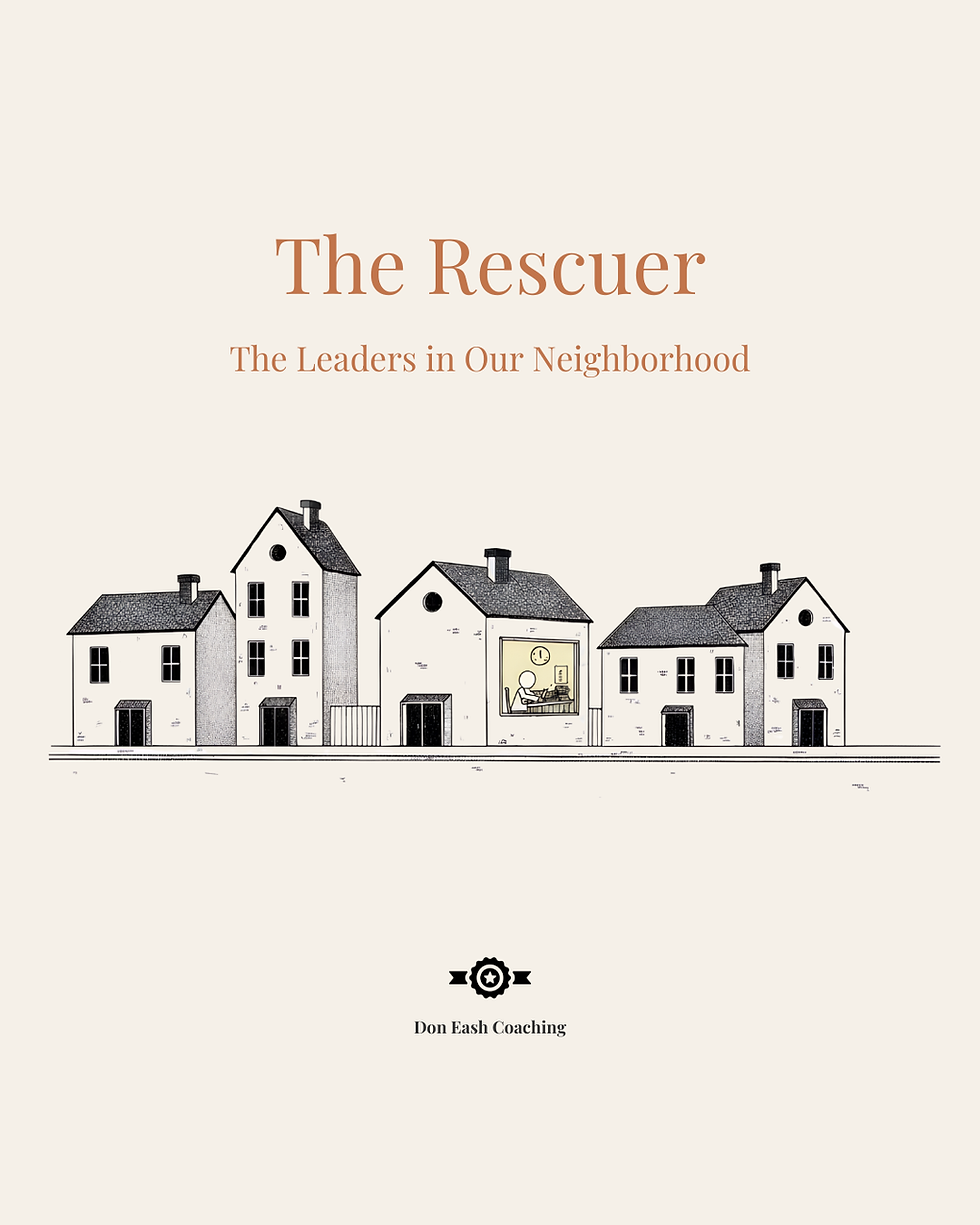
They’re the kindest person on your team. And they’re quietly breaking it.
In every organization, there’s someone who stays late on Friday.
Not because anyone asked. Not because there’s a deadline nobody else knows about. They stay because they looked at someone’s work and thought, I can’t let this go out like that. So they sit down, open the file, and fix it. Quietly. Without being asked. Without telling anyone.
They do this every week.
If you asked them why, they’d say something about standards. Or about caring. Or about how it’s just faster if they do it themselves. And they’d mean all of it. The Rescuer isn’t lazy. The Rescuer isn’t a micromanager. The Rescuer is usually one of the most competent, most caring people in the building.
That’s what makes this so hard to talk about.
I coached a leader once — we’ll call her Janelle — who spent every Friday afternoon doing exactly this. She’d pull up her team’s work, find the gaps, and quietly get everything back on the rails before the weekend. Hours. Every single week.
When I asked her what would happen if she just... didn’t — if she left at five on a Friday like a normal person — she looked at me like I’d suggested she leave a toddler in a parking lot.
“Things would fall through the cracks,” she said.
“They might,” I said. “And then what?”
She didn’t have an answer for that. Because she’d never let it get that far. She’d been catching every ball for so long that she had no idea whether her team could actually play the game without her.
Here’s the thing about The Rescuer that nobody says out loud: the rescuing isn’t about the team. It’s about the rescuer. It feels like leadership. It feels essential. And there’s a quiet identity wrapped up in being the one who always comes through — the person the whole thing would fall apart without.
But it’s not leadership. It’s a relationship pattern. And it’s serving a need in both directions.
The Rescuer gets to feel indispensable. The team gets to stop trying as hard. And every Friday, both sides get exactly what they’ve trained each other to expect. She fixes. They wait. Nobody grows.
I told Janelle something that landed differently than I expected: “You’re not delegating poorly. You’re in a codependency with your team.”
She went quiet. Because delegation sounds like a skill gap — something you can fix with a framework and a checklist. Codependency sounds like what it actually is: a pattern that’s meeting an emotional need, and breaking it is going to feel like loss before it feels like freedom.
What it’s like to live next door to The Rescuer.
If you work for one, you already know. You’ve learned — maybe without realizing it — that the bar is wherever The Rescuer sets it, not wherever you set it. Why push yourself to 95% when your boss is going to redo it anyway? Why take ownership of something that’s going to get quietly taken back?
You stop stretching. Not because you’re lazy. Because the system has taught you that stretching doesn’t matter.
And here’s the part that stings. The Rescuer’s team isn’t underperforming because they can’t do the work. They’re underperforming because their leader’s behavior has trained them that someone else will always catch it. It’s learned helplessness — built one Friday at a time by a person who genuinely cares about them.
That’s the cruelty of this pattern. The more you rescue, the more they need rescuing. And the more they need rescuing, the more essential you feel. It’s a loop. And it runs until someone deliberately breaks it.
If this sounds familiar — if you just read three paragraphs and felt personally attacked — take a breath.
You’re not a bad leader. You’re probably a very good one who learned a long time ago that your value came from being the person who comes through. That lesson served you well for years. It got you promoted. It built your reputation. It made you the one people trust when things get hard.
The problem is that the lesson hasn’t updated. You’re still running software from two roles ago. And at this altitude, your job isn’t to catch every ball. It’s to build a team that can play without you on the field.
I use a baseball analogy with my clients all the time: you can’t develop your team while you’re on the mound throwing every pitch. At some point, you have to step into the dugout. Your job is to prepare people, set them up, watch them play, and coach them between innings. Even when they give up a few runs. Especially when they give up a few runs. Because if they never throw, they never get better. And if they never get better, you never move.
One thing to try this week: pick one task you normally rescue. Let it go. Don’t fix it. Don’t mention it. Just watch what happens. Your team might surprise you. They might not. Either way, you’ll learn something you couldn’t learn while you were busy catching every ball.
The question on the porch:
If you got promoted tomorrow and your team had to run without you for sixty days — would they survive? If the answer is no, that’s not a reflection of their limitations. That’s a reflection of yours. And it might be the kindest thing you’ve ever been willing to look at.
The Leaders in Our Neighborhood is a series about the patterns we all recognize — in the people we work with, and sometimes in ourselves. If something here hit close to home, that’s not a problem. That’s a starting point.


Comments